Choosing your first set of bowls: size, weight and bias
The most expensive thing you'll buy in this sport, and the one most commonly bought wrong. Four decisions, in the order that matters.
A set of bowls is a several-hundred-dollar decision that most people make in about twenty minutes, based on a colour they liked and whatever the bloke in the shop had in stock.
They then spend two seasons blaming their delivery for a problem that is actually a bowl half a size too big.
Here are the four decisions, in the order that matters. Get the first two right and the rest is close to preference.
1. Size — the one that actually matters
Bowls are sized by number, roughly 00 up to 7 depending on brand. Bigger number, bigger bowl. Most adults land somewhere in the 3 to 5 range, but "most adults" is not a fitting.
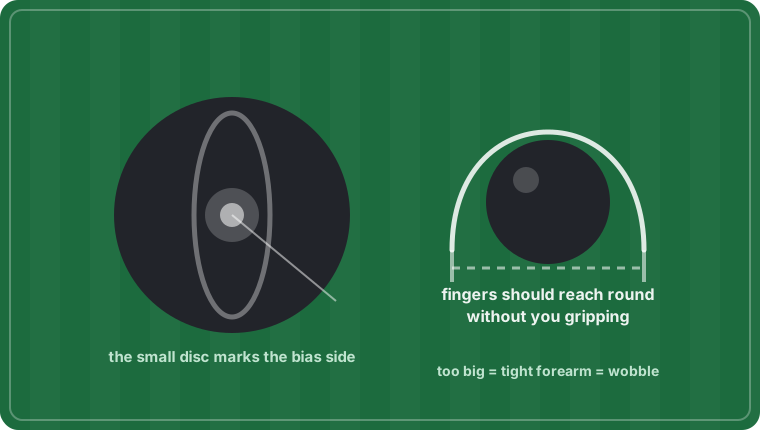
The size is right when you can hold the bowl securely without gripping it. That's the whole test. If your forearm is working, the bowl is too big, and everything downstream suffers: your grip tightens, your release gets tense, and the bowl comes out wobbling.
Two ways to check:
The span test. Hold the bowl in front of you between both hands, thumbs on top, fingers underneath, and see whether your middle fingers can reach around the bowl and come close to meeting underneath. Comfortably meeting means you have room; straining to reach means it's too big.
The drop test. Hold the bowl in one hand as you would to deliver it, then turn your hand so the bowl is facing the ground. A correctly sized bowl for a finger grip will sit there for a moment before it goes. If it drops instantly, it's too big for that grip. If you have to clamp to keep it, also too big.
Do both tests with the grip you actually use. A bowl that is perfect in a cradle grip can be a size too big for a finger grip, which is why "what size are you?" is an incomplete question.
Hand size changes. Arthritis, an injury, or just getting older will change what you can comfortably hold. Plenty of very good bowlers drop a size in their sixties and improve immediately. There is no prize for holding a big bowl.
2. Weight
Within a size, most brands offer a heavier and a lighter option. The Laws cap how heavy a bowl may be, and modern bowls sit close to that cap by default.
The trade-off is simple:
- Heavier — more stable, holds its line better in wind, less affected by a rough patch of green. Harder work over a long day, and less forgiving if your delivery is at all tense.
- Lighter — easier to control at the end of a long tournament, kinder to shoulders and backs. More easily knocked out of the head, more affected by wind on a fast green.
For a first set, err heavier only if the size is genuinely comfortable. If there's any doubt, lighter. A bowl you can still deliver smoothly in your fourth game of the day beats a bowl that was theoretically better in game one.
3. Bias and model
Every bowl bends. All legal bowls meet a minimum bias standard, so no bowl is straight — but models differ a lot in how they bend and where.
Broadly:
- Narrower models hold a tighter line and turn late. They suit fast greens, confident line bowlers, and players who like the bowl to come in hard at the finish.
- Wider models draw more, and turn earlier and more gradually. They suit heavier greens, and they're more forgiving of a bowl delivered slightly narrow — the extra swing rescues you.
For a first set, go with a middle-of-the-road model, and choose it for the green you actually play on. If your home green runs slow, a very narrow bowl will make you work far too hard for every draw shot. If you play mostly on quick summer couch, a very wide bowl will have you aiming into the next rink.
Talk to two or three people at your club who've been there for years — not about which brand is best, but about which models work on your green. That's local knowledge and it's genuinely valuable.
4. The stamp — check this before you buy anything second-hand
Every bowl carries a stamp, and competitions require that stamp to be current. Requirements differ by country and by level of competition, and they do change.
Before you buy a second-hand set, check the stamp date on the bowl and confirm the current requirements with your club or state association. A cheap set of bowls you can't use in pennant is not a bargain, and re-testing costs money and takes time.
This is the single most common way a first-time buyer gets burnt.
Buying second-hand: worth it, with conditions
For a first set, second-hand is genuinely sensible. Bowls last a long time, plenty of people upgrade or stop playing, and clubs often have sets sitting in a cupboard.
The conditions:
- Current stamp (see above). Non-negotiable.
- Check for chips and deep scratches on the running surface. Cosmetic marks on the sides are fine; damage on the part that touches the green is not.
- All four match — same size, same model, same date. A mismatched set is a set of four different bowls.
- Try them first. Take them for a roll-up. Any club will let you.
What to do this week
- Borrow three different sizes from the club cupboard.
- Do the span test and the drop test on each, with your own grip.
- Bowl an end with each size, on both hands, paying attention only to whether your hand feels relaxed.
- Ask two long-standing members which models suit your home green.
Twenty minutes of that beats any amount of reading, including this. The best set of bowls is the one you stop noticing.
The Monday drill
One short email a week: a drill to try, and the fix that solved someone's problem on the green.