Six drills you can do alone on an empty green
No opponent, no coach, no partner to roll the jack back. Here's how to turn an hour by yourself into an hour that's actually worth something.
Most solo practice is a bowler delivering thirty-two bowls at a jack, thinking "that was a good one," and going home no better than they arrived.
The problem isn't effort. It's that bowling at a jack gives you almost no information. You can see where the bowl finished, but not why, and without the why there's nothing to correct.
These six drills each isolate one variable. Do one properly for twenty minutes rather than all six badly for two hours.
1. The short-of-the-jack drill (weight)
What it fixes: too much weight, which is the cause of most narrow bowls.
Put the jack at a medium length. Deliver four bowls, trying to make every one finish half a metre short of the jack. Not at it. Short.
Almost everyone who's been running narrow will find their deliberately-short bowls finish dead level with the jack. That gap is exactly how much extra weight you've been carrying without knowing it.
Repeat at three different jack lengths. Weight control is the foundation everything else sits on — do this before any line work in every session.
2. The weight ladder (range)
What it fixes: the mysterious hole in your game at one particular length.
Set the jack at minimum length. Bowl four. Move it two metres longer. Bowl four. Keep going until you reach maximum length, then work back down.
Most bowlers discover one specific length where they fall apart — usually a bit shorter than they're used to, because clubs default to comfortable lengths. That's the length your opponents will find eventually. Better you find it first.
3. The line drill with a string (alignment)
What it fixes: delivering across your body, which is the fault that makes you narrow on one hand only.
Lay a length of string or a chalk line from the mat out along your aiming line. Then:
- Set up with feet, hips and shoulders square to the string.
- Step down the line without a bowl, ten times, watching your foot land on the string, not across it.
- Add the bowl. Deliver so your hand passes directly over the string and your follow-through finishes pointing down it.
Do both hands. Almost everybody is clean on one and messy on the other, and the messy one is the "weak hand" they've been quietly avoiding for years. More on the four causes of a narrow bowl here.
4. Alternate hands, every bowl (removing the weak hand)
What it fixes: having a hand you don't trust.
Forehand, backhand, forehand, backhand — the entire session. Never two in a row on the same hand.
This is deliberately uncomfortable. Bowling four on one hand lets you find a groove and hides the difference between your hands; alternating forces both to work from cold, which is exactly what a match demands when the skip calls you onto the hand you don't like.
Give this one a month before you judge it. It's the drill with the biggest gap between how it feels and what it delivers.
5. The target circle (accuracy under a standard)
What it fixes: vague practice with no pass mark.
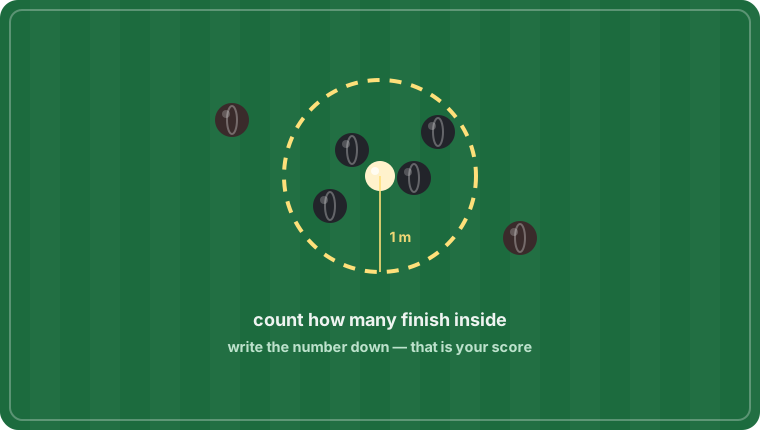
Put the jack down and lay a rope or four markers in a circle around it, roughly a metre across. Deliver eight bowls. Count how many finish inside the circle.
Now you have a number. Write it down. Next session, do it again.
The point isn't the circle — it's that "I bowled well today" is not measurable and "five out of eight, up from three" is. Shrink the circle when you're regularly getting six.
6. The one-bowl pressure drill (the mental bit)
What it fixes: the thing that actually goes wrong on Saturday.
Everything above is repetition, and repetition builds a delivery that works when nothing is at stake. That is not the same skill as delivering one bowl that has to be good.
So: walk to the far end. Walk back. Set the mat. Read the green. Deliver one bowl, as though it's for the match. Then walk down, pick it up, walk back, and do the whole routine again.
Ten of these takes twenty minutes and is far more tiring than a hundred casual bowls. It's also the closest thing to match conditions you can create alone — because the walk is the bit where the doubt gets in, and practising with the walk included is the only way to get used to it.
Building a session
A useful hour, if you want a template:
| Minutes | Drill |
|---|---|
| 0–15 | Short-of-the-jack (weight first, always) |
| 15–30 | One technical drill — string line, or alternate hands |
| 30–45 | Target circle, and write the score down |
| 45–60 | One-bowl pressure drill |
Two of those a week will move your game more than four social games, because a social game gives you maybe eight meaningful bowls and no feedback on any of them.
The one rule
Change one thing at a time, and give it three sessions.
Bowlers who fiddle with grip, stance and weight in the same hour end up worse, conclude that practice doesn't work, and go back to turning up on Saturday and hoping. One variable, three sessions, then judge it. That's the whole method.
The Monday drill
One short email a week: a drill to try, and the fix that solved someone's problem on the green.