Forehand or backhand: how to actually choose
Most bowlers pick a hand out of habit and then blame the bowl. Here's the decision as an experienced skip actually makes it — five questions, in order.
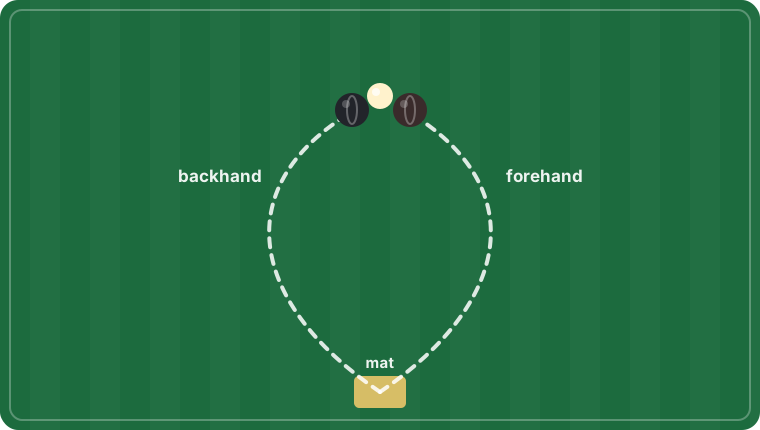
Ask ten club bowlers which hand they prefer and nine will tell you instantly. Ask them why and you'll get "I just bowl better on my forehand." Sometimes that's true. More often it means "I bowl my forehand more, so I bowl it better, so I bowl it more."
That's a fine habit until the day the head demands the other hand and you have no idea what your bowl is going to do.
Here's the decision the way a good skip makes it — five questions, in order. Stop at the first one that gives you a clear answer.
1. Which hand is running true today?
Before tactics, before the head, before anything: is this rink behaving the same on both hands?
It usually isn't. Rinks wear. The centre of a green gets more traffic than the edges. Drainage, mowing direction, a slight fall towards one side — any of it can make a rink take a foot more green on one hand than the other, or make one hand run a fraction faster.
This is what trial ends are actually for, and most bowlers waste them. Don't use your trials to "get a feel." Use them to collect two specific facts:
- How much green each hand takes (where the bowl crosses the halfway mark, not where it stops).
- Whether either hand has anything odd in it — a flat spot, a late grab, a run-off near the ditch.
If one hand is running true and the other is doing something strange, you've answered the question for the whole game. Bowl the true hand unless something forces you off it.
2. What is the shot you're actually being asked to play?
The hand should be chosen by the task, not by preference.
Drawing to an open jack: either hand. Go to your truer one (question 1).
Drawing to a jack that's been moved to one side of the rink: the hand that gives you more room. A jack sitting close to the rink boundary on the left leaves your forehand (for a right-hander) with less green to work with — the arc wants space that isn't there, and the bowl finishes in the neighbouring rink or the ditch. Take the hand that lets the bowl bend into the jack rather than out of the rink.
Playing a resting toucher or a shot with a bit of weight: the hand where you know your line best, because with added weight the bowl bends less and errors magnify. This is not the moment to experiment.
Drive or heavy weight: the straighter path is the shorter path. Choose the hand with the cleaner corridor to the target, and accept that at drive weight the hand matters far less than the line through the head.
3. What's in the way?
Look at the head from the mat, crouched, at bowl height — not standing up where everything looks open.
The question is not "which hand looks nicer." It's: where is the front bowl on each hand, and can I get past it?
A single short bowl sitting on your forehand at three-quarter length is a wall. Your bowl arrives on a similar arc and hits it. The backhand may be technically your weaker hand and still be the right choice, because a mediocre bowl down an open corridor beats a good bowl into a blocker.
The corollary that costs people games: if the head is open on both hands, don't go to the crowded side out of habit.
4. What does the head need — inside or outside?
Every developing head has a "front" — the side the shot bowl is being defended from. Your job is either to add to your own side or attack theirs.
- You hold shot and want to protect it: bowl the hand that puts your next bowl in front of or beside your shot bowl, blocking the path your opponent needs. That's often the hand you didn't just use.
- They hold shot and it's guarded on one hand: go the other way. Second shot from an unexpected angle is worth more than a heroic attempt through traffic.
- The count is against you (three or four down): you're not drawing your way out. Pick the hand that gives the cleanest line to the jack for a weighted shot and take the head apart.
5. Wind, sun, and the state of your own body
The tie-breakers, only if 1–4 haven't decided it:
- A strong cross-wind genuinely widens one hand and tightens the other on a fast green. If you're taking noticeably more green on one hand than the wind-free norm, that's why.
- Low sun in your eyes on one hand ruins your ability to see the aiming marker. That alone is a reason to use the other hand.
- A sore shoulder or hip often flattens the delivery on one side. If you're forty ends into a tournament day and one hand has quietly deteriorated, use the other one and stop being stubborn about it.
The practice that makes this possible
None of this works if one of your hands is a genuine unknown. And the reason most bowlers have a bad hand is not talent — it's that they've delivered ten times as many bowls on the good one.
The fix is not complicated, just unglamorous: alternate every bowl in practice. Forehand, backhand, forehand, backhand, all session, for a month. Don't bowl four of one and then four of the other, because that lets you settle into a groove and hides the difference. Alternating forces both hands to be repeatable from cold, which is exactly what a match demands.
Two things usually turn up:
- Your weak hand takes a different amount of green than you assumed — often less, because your body is quietly delivering it tighter.
- Your weak hand has a physical quirk. Nearly always one of: shorter step, shoulders opening at delivery, or the arm swinging across the body instead of under the shoulder.
That second one is worth chasing down, because it's fixable in a session or two once you can see it — and it's the reason "I just bowl better on my forehand" was never really about preference.
The short version
Bowl the hand the rink is behaving on. If both behave, bowl the hand the shot needs. If the shot doesn't care, bowl the hand that isn't blocked. If nothing's blocked, bowl the hand that helps the head you're building.
Preference comes last, not first. That single reordering is worth a shot or two a game to most club bowlers — and it costs nothing to start on Saturday.
The Monday drill
One short email a week: a drill to try, and the fix that solved someone's problem on the green.