Reading a green: speed, swing, and what "14 seconds" actually means
Green speed is a number almost everyone quotes and very few can explain. Here's what it measures, how to work it out with a stopwatch, and what to change when it goes up.
Someone at your club says "she's running about fifteen today" and everyone nods. Some of them know what it means. Quite a few are nodding because everyone else is.
It's worth actually knowing, because green speed is the one number that changes every other decision you make — your line, your weight, which lengths favour you, and how badly a small error gets punished.
What the number measures
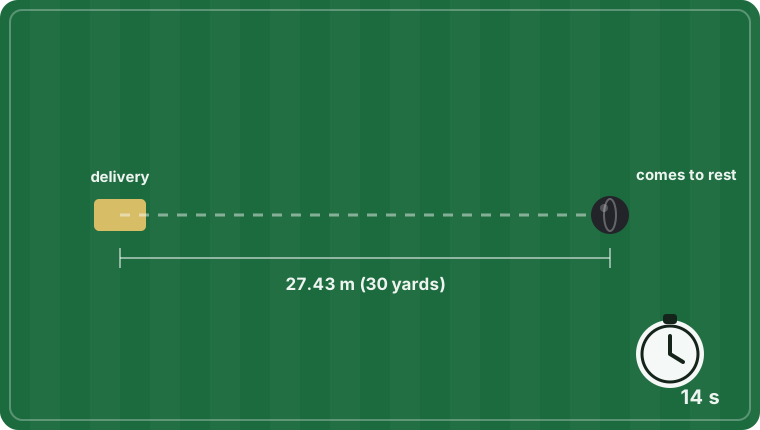
Green speed is the time in seconds a bowl takes to travel a set distance and come to rest — measured over 27.43 metres (30 yards) from the point of delivery, under the standard test.
Two things follow from that definition, and both trip people up:
A higher number means a faster green. This feels backwards — bigger number, more seconds, sounds slower. But you're timing a bowl that has been rolled just hard enough to stop at the mark. On a fast, tight, dry surface the bowl needs very little push, so it trickles along and takes a long time to get there. On a heavy, slow green you have to give it a shove, so it arrives quickly. Sixteen seconds is quick. Twelve is a paddock.
It's a whole-green average, not a promise about your rink. The test distance is shorter than a full end, and greens are not uniform. Your rink might run half a second different from the one next to it.
Rough guide to what you'll meet:
| Seconds | Feels like | Where you'll find it |
|---|---|---|
| 11–12 | Heavy. Real effort to get there. | Wet winter grass, poorly drained greens, new turf |
| 13–14 | Average club green | Most weekend pennant in Australia |
| 15–16 | Quick. Very little weight needed. | Well-prepared couch greens, dry summer, tournament prep |
| 17+ | Glassy. Punishing. | Championship greens at their peak |
| 13–15 | Consistent and honest | Indoor carpet |
Championship conditions typically call for a green of at least 14 seconds, which is why bowlers who only ever play on a slow home green often struggle badly the first time they travel.
How to measure it yourself
You don't need officials or a testing device to get a workable number.
- Mark a point 27.4 metres from the mat. A tape measure is best; if you don't have one, most rinks are marked and 27.4 m is a bit over half the length of a standard 37-metre-plus end — measure it properly once and note a landmark.
- Deliver a bowl aiming to have it stop right on that mark.
- Start the stopwatch at the moment the bowl leaves your hand and stop it the instant the bowl stops moving.
- Repeat six times. Discard any bowl that finished well short or well past. Average what's left.
Do it on both hands. If the two averages differ by more than about half a second, that's not measurement error — that's your rink telling you it has a preferred side, which is useful information for every game you play there.
What actually changes when the green speeds up
You need more green
This is the big one. A faster green means the bowl spends longer in the slow part of its run, which is where the bias does its work. More time bending equals more bend. A green that takes three-quarters of a metre of green at 13 seconds might take well over a metre at 16.
Practically: your aiming marker moves wider as the green quickens. If you play the same club all summer, you'll learn that your marker moves a sign or two along the bank between the cool early rounds and the January heat.
Weight errors get punished harder
On a heavy green, a bowl delivered 10% too hard finishes maybe a foot long. On a 16-second green, the same 10% might carry it two metres past the head and into the ditch. Fast greens are less forgiving of the same mistake, which is why fast-green bowlers develop such delicate weight control — they have no choice.
Length preferences flip
On a heavy green, a long jack is hard work; a lot of bowlers can't reliably get there and the game shrinks. On a fast green, long jacks become comfortable and short jacks get fiddly, because at very low weight small inconsistencies in the surface start to matter.
If you're the one controlling the jack length, this is a real lever. Move the jack to a length your opponent is visibly struggling with.
The green changes during the day
Grass greens dry out. A green measured at 13.5 in a shaded 8am start can be over 14.5 by mid-afternoon. Rain does the opposite, and fast.
Two habits worth building:
- Re-read after any break. Coming back from lunch or a shower, treat the first end as a fresh trial end mentally, even if you can't bowl one.
- Adjust the marker, not the swing. When the green quickens, move your aiming point wider and deliver the same. Bowlers who try to "put a bit more bend on it" are inventing a new delivery under pressure and it never survives.
Speed is not the same as swing
Related, but different, and mixing them up causes a lot of confusion.
- Speed is how far a bowl runs for a given effort. It's a property of the surface.
- Swing (or draw) is how much the bowl bends. It's speed plus your bowl's bias plus how much weight you're carrying.
That's why two bowlers on the same 15-second green take different amounts of green: one has narrow-bias bowls and a firm delivery, the other has a wider-bias set and a softer touch. The green is the same. The swing isn't.
Which means the only useful version of "how much green does it take?" is how much green does it take for me, with these bowls, today. Borrowing a clubmate's aiming marker is a fast way to be narrow all afternoon.
Your first two ends, as a checklist
Every game, before you care about anything tactical:
- Deliver on the forehand. Note where the bowl crossed the halfway point — that's your arc.
- Deliver on the backhand. Same.
- Note whether either hand is running strangely — a flat spot, a late grab, a wander near the ditch.
- Pick a fixed marker on the bank for each hand.
- Note whether the bowls are finishing short, level or long, and adjust weight before you touch the line.
Five things, ninety seconds, and you'll start the game knowing more than most of the people on the rink.
The Monday drill
One short email a week: a drill to try, and the fix that solved someone's problem on the green.